
Catholic Daily Reflections – October 27, 2026 – Tuesday of the Thirtieth Week in Ordinary Time – Gospel: Luke 13:18-21
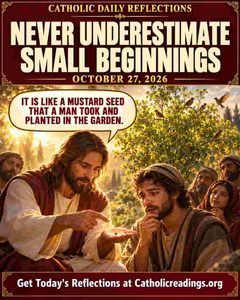
Reflection Theme: Never Underestimate Small Beginnings – Let Your Gifts Grow God’s Kingdom
You have a small talent.
A simple idea.
A little knowledge.
A dream that seems insignificant.
And you wonder whether it can really make a difference.
Today, Jesus gives us a powerful answer.
A tiny mustard seed becomes a shelter for birds.
A little yeast transforms an entire batch of dough.
Never underestimate what God can accomplish through small beginnings offered with faith, love and perseverance.
Main Luke 13:18-21 Reflection
In today’s Gospel, Jesus uses two simple examples from everyday life to explain something extraordinary about the Kingdom of God.
First, He compares the Kingdom to a mustard seed that someone plants in a garden. Although the seed begins very small, it eventually grows into a large bush where birds can find shelter.
Then Jesus compares the Kingdom to yeast that a woman mixes into flour. The yeast may seem insignificant compared with the quantity of dough, but gradually its influence spreads throughout the entire mixture.
These two parables reveal a beautiful truth about how God’s Kingdom grows.
God often begins His greatest work through things that appear small, ordinary and easily overlooked.
The Kingdom does not depend on impressive appearances, extraordinary resources or immediate recognition. It grows through God’s grace, transforming human hearts and extending His love into the world.
And that message should change the way we think about our abilities, opportunities and daily responsibilities.
Great Things Do Not Always Begin Great
We live in a world fascinated by extraordinary achievements.
We celebrate successful businesses, influential leaders, famous personalities, large organizations and people whose work attracts worldwide attention.
There is nothing necessarily wrong with these achievements. The problem begins when we assume that only something large, famous or highly visible can make a meaningful difference.
Jesus challenges that assumption.
The mustard seed does not need to appear impressive before it can begin growing. It simply needs to be planted in suitable soil and allowed to develop.
In the same way, you do not need to possess extraordinary wealth, hold an important position or command a large audience before you can begin serving God.
Perhaps you are a teacher helping one struggling student understand a difficult lesson. Maybe you are a parent patiently teaching your child honesty and kindness. Perhaps you are a young professional using your skills to solve a problem that others have overlooked.
These actions may appear ordinary, but they can become part of something far greater than we initially recognize.
What matters is not merely the size of the beginning, but whether that beginning is rooted in something good.
One Small Act Can Change a Life
Imagine a teacher working in a school where many students struggle with reading.
The teacher recognizes that one particular student has fallen behind and is gradually losing confidence. Other students have begun making fun of the child’s mistakes, and the child increasingly avoids participating in class.
The teacher could simply continue with the normal lessons and leave the struggling student behind.
Instead, the teacher decides to spend a few extra minutes providing patient guidance.
There is no special award, financial bonus or public recognition attached to this decision. It is simply a teacher using professional knowledge with compassion.
After some time, the student begins improving. Confidence grows, class participation increases and learning becomes less frightening.
Years later, the student may remember that encouragement as an important turning point.
The teacher may never know the full effect of those few minutes of attention.
But that is precisely the point of today’s Gospel. We cannot always measure the eventual influence of the good we do today.
The mustard seed does not look like a shelter when it is planted.
It becomes one through growth.
Your Gifts Can Become Like Yeast
The second parable adds another important dimension.
Yeast works quietly within the dough. Its influence is not immediately obvious, but it gradually affects the whole mixture.
This provides a powerful lesson about our talents, gifts, skills, passions and knowledge.
You may possess leadership ability that helps create a more respectful workplace. Your communication skills may encourage someone who has lost confidence. Your knowledge of technology may help an organization serve people more effectively.
Perhaps your strongest ability is listening carefully and offering wise guidance.
These gifts do not always produce dramatic results that attract public attention.
Sometimes their greatest influence is hidden.
A compassionate manager can gradually transform a workplace culture. A patient parent can help shape a child’s character. An honest business owner can encourage integrity among employees and suppliers.
This is how our abilities can become instruments of God’s goodness.
But there is an important condition: the influence must be guided by love, truth and faithfulness.
Not every form of influence is good. Talents can also be used selfishly, dishonestly or irresponsibly.
The challenge is to allow Christ to transform the person using the gift so that the gift increasingly serves what is right.
Why Did God Create Us?
This brings us to the question that gives our lives their deepest meaning: Why did God create us?
God created us to know Him, love Him, serve Him and ultimately share eternal life with Him.
That calling is greater than any profession, qualification, business or earthly achievement.
Before we can effectively direct our particular gifts toward God’s service, we need to understand this fundamental reason for our existence and seek to recognize the talents, skills, passions and knowledge He has entrusted to us.
We do not need perfect knowledge of our entire future before beginning to serve. But understanding our calling helps us recognize that our abilities should become instruments of love rather than merely tools for personal advancement.
A gifted teacher can help students discover their potential. A healthcare professional can bring competent and compassionate care to people who are suffering. A business owner can create employment and provide honest services that improve people’s lives.
Each person contributes differently.
And today’s Gospel reminds us that even apparently small contributions can participate in the growth of God’s Kingdom.
We should therefore stop measuring the value of our lives exclusively by income, recognition, popularity or the size of our achievements.
The deeper question is whether our lives are becoming fruitful expressions of our love for God and our neighbor.
True Growth Begins With Love
Today’s first reading from Ephesians strengthens this message through Saint Paul’s teaching about self-giving love, mutual responsibility and the relationship between Christ and His Church.
Christ’s love is not selfish. It gives, nurtures and seeks the good of the beloved.
That same spirit should guide the way we use our abilities.
A talented leader should be concerned not only with organizational success but also with the well-being and development of the people entrusted to that leadership.
A knowledgeable professional should be willing to guide others rather than protect knowledge simply to remain important.
A successful person should recognize opportunities to create value for others rather than treating every achievement as a personal trophy.
These actions may appear small, but they help create environments in which goodness can grow.
The yeast changes the dough from within.
In the same way, Christ’s love should gradually change our motives, attitudes, relationships and decisions.
Do Not Despise the Season of Small Beginnings
Sometimes we become discouraged because our progress appears insignificant.
Perhaps you have been developing a skill for years but have not received the opportunities you hoped for.
Maybe you have started a small business that is growing more slowly than expected. Perhaps you have been serving faithfully in your community without recognition.
Today’s Gospel offers encouragement, but it also calls us to patience and trust.
Not every small business will become a large company. Not every talent will lead to fame, and not every act of service will produce results we can immediately see.
The Kingdom of God is not simply a promise of professional success.
It is the transforming presence and reign of God, which can grow through faithful lives whether or not those lives become publicly celebrated.
Our responsibility is to cooperate with God’s grace, develop what He has entrusted to us and remain faithful in the opportunities available today.
The results ultimately belong to Him.
Today’s Call to Action
Think about one talent, skill, idea or opportunity you have been neglecting because it seems too small to matter.
Perhaps you have been waiting until you have more money, better qualifications, greater confidence or a larger audience.
Ask yourself whether you could begin using that ability to serve someone today.
You might mentor one young person, help one struggling student, encourage one discouraged colleague or solve one problem that affects your community.
Begin with what you have and improve your ability as you grow.
At the same time, examine the influence your daily actions are having on the people around you.
Are your words building confidence or destroying it? Are your decisions encouraging honesty and compassion? Does your presence make it easier for others to grow?
Do not wait until you can do something extraordinary before you begin doing something good.
Plant the seed. Allow Christ to transform your heart. Serve faithfully and trust God with the growth.
Luke 13:18-21 Reflection Resolution
Today, remember that God can accomplish meaningful things through the smallest acts of faith, love and service. Never allow limited resources, lack of recognition or a humble beginning to convince you that your contribution has no value.
Serve with humility, speak with kindness and carry your responsibilities with faith. Develop your talents, gifts, skills, passions and knowledge with excellence, and use them so faithfully that the people you encounter can sincerely thank you and praise the God you worship.
Let your life testify that God is real, God is good and God is at work in you.
When success comes, never claim that you achieved everything by yourself. Acknowledge God’s strength, grace and providence.
You may begin with something as small as a mustard seed, but when your life is rooted in Christ, even your smallest acts of love can contribute to the growth of His Kingdom.
Closing Prayer
Heavenly Father, thank You for the gift of life and for every talent, skill, passion, opportunity and ability You have entrusted to me.
Lord Jesus, teach me never to underestimate the good You can accomplish through humble beginnings.
Forgive me for the times I have compared myself with others, neglected my gifts or allowed the desire for recognition to discourage me from serving.
Help me understand why You created me and guide me in discovering, developing and faithfully using my talents, gifts, skills, passions and knowledge.
Give me patience when growth is slow, courage when opportunities seem limited and perseverance when my efforts appear insignificant.
Holy Spirit, transform my heart as yeast transforms dough. Let Your grace influence my thoughts, words, decisions and relationships.
May my knowledge bring understanding, my abilities provide useful service and my actions help others experience Your goodness.
Keep me humble in success and faithful in small responsibilities.
May everything I do contribute to the growth of Your Kingdom and bring glory to Your holy name. Amen.
If today’s Luke 13:18-21 Reflection inspired, encouraged or challenged you, please like and share this post with someone who may need this message.
Please like and share the post, subscribe to our YouTube channel, and follow us on Facebook, WhatsApp, X, and Threads. Find more Catholic Daily Reflections at CatholicReadings.org.
Follow @ReadingCatholic
