
Luke 16:9-15 reflection for November 7, 2026 – Catholic Daily Reflections for Saturday of the Thirty-first Week in Ordinary Time.
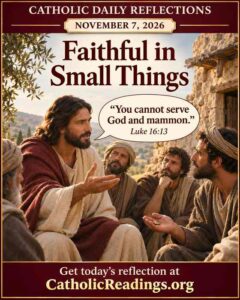
Reflection Theme – Faithful in Small Things
Two payments. One bag of flour.
The customer has already walked home.
You could close the till. You could keep quiet. Or you could call her back.
A few coins can feel like a small thing until they are yours and you need them for supper.
Jesus sees the person on both sides of the counter. Today he asks us to see her too.
Luke 16:9-15 Reflection – Faithful in Small Things
Jesus has just told his disciples the parable of a steward who knew his time in office was running out. Now he asks them to think about their own use of money. A sum of money can pass through our hands in seconds. The way we handle it can stay with another person for years.
Think of a neighbour who once lent you the fare to get home. You may have forgotten the amount. You probably remember the relief of finding someone you could ask. When Jesus speaks of making friends through the use of earthly wealth, that memory can help us hear him. Something temporary met a real need and made room for a human being.
What Becomes of the Money in Our Hands?
Money buys bread, pays a caregiver, and keeps a family housed. It can also tempt us to hide where it came from or to see someone in need as an inconvenience. Jesus asks his disciples to put earthly goods at the service of relationships that matter to God. A person who shares a meal with us deserves a seat even when there is nothing they can do for us in return.
The eternal welcome Jesus speaks about is God’s gift. We receive it through his mercy. Giving alms lets us answer that mercy with love. If some of the money in our hands belongs to someone else, love begins by giving it back. A generous gift and an unpaid debt can sit side by side in the same account. Only one of those sums is ours to give.
A Shop Assistant Finds a Second Payment
Imagine Miriam, a shop assistant, looking through the day’s payments as she closes. A regular customer paid twice for one bag of flour. Both payments went through. The first thought that comes to Miriam is how neatly the extra sum would cover a shortage from yesterday. Her supervisor has already asked about the shortage. She would like to have an answer before morning.
She looks again at the sales record. One bag went across the counter. Yesterday’s shortage still needs an explanation, and today’s customer needs her money. Miriam shows her supervisor both entries, records what happened, and helps arrange the refund. The customer sees the refund on her phone before she has even noticed the second payment. It saves her a return trip to the shop to ask what happened.
Miriam still has an uncomfortable conversation ahead. Her supervisor may appreciate her honesty or may barely notice it. What changed is easier to name. A woman has the money she needs for her household, and the shop’s books tell the truth. That is already a good worth choosing, even if Miriam spends the rest of her working life at the same counter.
When a Good Servant Starts Giving Orders
Jesus says, “You cannot serve God and mammon.” Mammon means wealth. Most of us recognise the moment money starts giving orders. A worker is owed a wage, but paying it today would leave less profit on the books. A relative needs our company, but we find it easier to send a little cash and avoid the visit. In each case, someone is waiting for more than a calculation.
Serving God begins by letting him name the good we owe that person. A wage should be paid when it is due. A lonely relative may want an hour at the table with a familiar voice. Planning a budget can help us keep both commitments. We can provide for our household, remember people who depend on us, and set aside something to share as our means allow.
Some of the Pharisees in this passage ridicule Jesus. He answers by speaking about what God sees in the heart. That turns the examination back on each reader. A gift made in public may be sincere, and a gift made quietly may carry a hidden demand for gratitude. In prayer we can tell the Lord the truth about a mixed motive and ask him to purify our love.
Let Someone Share Your Burden
Saint Paul offers another view of generosity in the first reading. The Philippians have sent him help. He knows what it means to go hungry and what it means to have enough. His confidence in Christ gives him strength in both conditions, and he takes care to thank the people who shared his distress.
There are days when the faithful act is to accept a bag of groceries. Perhaps you once filled another family’s cupboard and now your own is empty. Needing help can make it hard to look a friend in the eye. Paul’s gratitude gives us words for that moment. We can name the good the gift did and let the giver know that their kindness reached us.
Psalm 112 gives us the image of a just person whose generosity reaches the poor. In any community, that care can travel in both directions over a lifetime. The neighbour who brought supper after a funeral may one day need a lift to Mass. Remembering what we have received helps us offer help in a way that leaves another person’s dignity intact.
Why Did God Create Us?
When we let God direct our money, we begin to notice the other things he has placed in our care. Behind every decision about our gifts lies a question. Why did God create us?
God made us to know him, love him, and serve him, and to share his life forever. That vocation can take shape through our talents, skills, passions, and knowledge. Someone who handles figures accurately can help a parish treasurer explain an account. A person who loves cooking can teach a young adult how to prepare three affordable meals. Each gift finds a neighbour it can serve.
Our worth rests in God’s love even on days when illness or exhaustion leaves us with little to offer. Holiness can take the form of accepting care, asking forgiveness, or thanking the person who stayed. In the Eucharist, Christ first gives himself to us. We go from his table able to look at the person across our own counter and ask what love requires today.
Today’s Call to Action
Choose one small matter that concerns something entrusted to you. You might have a book to return, a payment to check, or a child’s savings you promised to keep safe. Take a few minutes to attend to it today. If someone is waiting, let them know what you have done.
Then make room for one act of generosity within your means. Ask the person what would help. An hour spent taking someone to an appointment may be more welcome than the present you had in mind. Before bed, remember their face in prayer and thank God for whatever they shared with you.
Luke 16:9-15 Reflection Resolution
Today I will handle another person’s money and belongings with the care I hope someone would show my own. When a figure looks wrong, I will take the time to check it. When I owe an explanation, I will speak to the person who is waiting for it.
I will also look for one place where a skill of mine could ease a burden. I can offer a little time, agree on a task I can finish, and follow through. If I am the one in need, I will try to receive kindness with gratitude.
May someone who deals with me today have reason to believe that God is real, that God is good, and that his grace is at work in an ordinary life.
Closing Prayer
Lord Jesus, you know what I carry into this day. You know the bills that worry me, the help I am grateful for, and the sum I keep telling myself is too small to matter. Let me see the person whose life my next choice will touch.
When someone trusts me with what belongs to them, make my hands careful and my words truthful. Give me courage to admit a mistake while I can still put it right. If I have made another person feel small for asking what I owe, teach me to ask their forgiveness.
Thank you for the people who have fed me, taught me, and given me time they could have used for themselves. Bless them in the needs they carry today. Show me how to share what I have and how to receive help without shame.
Keep my heart free to serve you when I have plenty and when I have little. At the close of this day, draw me back to your table, where I remember what you have already given for love of me. You live and reign for ever and ever. Amen.
Readings and Further Reflection
Pray with Philippians 4:10–19, Psalm 112:1b–2, 5–6, 8a, 9, and Luke 16:9–15. Read the Catholic Daily Mass Readings for November 7, 2026 or the day’s liturgy on the USCCB website.
For a closer look at what we owe our neighbour through the use of our possessions, read Pope Francis’s audience on the Seventh Commandment.
Meet the saints, pilgrims, and workers remembered in Today in Catholic Church History November 7.
Follow CatholicReadings.org for daily readings, reflections, and Church history on Facebook, YouTube, WhatsApp, X, and Threads.
Follow @ReadingCatholic
