
Today in Catholic Church History – November 2 brings together prayer for the dead, the beginning of a remarkable priestly ministry, and powerful reminders of the suffering caused by war.
The Church observes All Souls’ Day, remembering the faithful departed and asking God to bring them into the fullness of his light and peace. This prayer has deep roots in Christian life.
On this date in 1946, the future Pope Saint John Paul II celebrated his first Masses in Kraków. In more recent years, papal visits to cemeteries have placed Christian hope beside the tears of grieving families.
These November 2 events invite us to remember with love, pray with trust, and use the life we have today to serve God and one another.
Historical note: The Cluniac observance is traditionally dated to 998; it concerns the development of a common November 2 commemoration, rather than the beginning of Christian prayer for the dead. The other entries below concern events documented on November 2.
1. 998 – The Cluniac Roots of All Souls’ Day
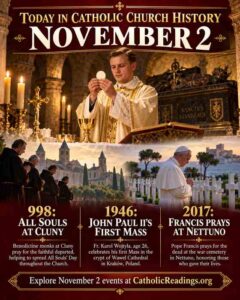
The common November 2 remembrance of the dead is traditionally traced to Saint Odilo, abbot of Cluny, in 998. He established the observance in the monasteries under his authority. Vatican News identifies this as an important stage in the history of All Souls’ Day.
Christians had prayed for the dead long before this. The Cluniac practice gave a shared day of remembrance a lasting place in monastic life, and the observance later spread more widely.
The anniversary reminds us that communal prayer can help a good practice endure. Families and parishes can likewise set aside time to remember the dead, including people who have no one regularly praying for them.
2. 1789 – Church Property Is Placed at the Disposal of the French Nation
On November 2, 1789, France’s National Constituent Assembly decreed that the property of the clergy should be placed at the disposal of the nation. The French National Assembly’s historical account records both the date and the financial crisis behind the decision.
In return, the state was to assume expenses connected with Catholic worship. The measure became a major part of the changing relationship between the Church and the revolutionary state.
This event deserves careful historical attention. It concerns property, public finance, and religious institutions; later revolutionary measures should not all be assigned to this single date. Remembering it helps us understand the pressures that reshaped Catholic life in France.
3. 1889 – Blessed Pio Campidelli Dies
On November 2, 1889, Pio Campidelli, a young Passionist religious, died of tuberculosis at the age of twenty-one. Also known as Pio of Saint Aloysius, he had hoped to become a priest but died before reaching ordination.
His life was marked by prayer, devotion to Christ’s Passion, and fidelity to ordinary duties. The Dicastery for the Causes of Saints recalls his generous response to a life limited by fragile health.
John Paul II beatified him on November 17, 1985. His death anniversary encourages people whose plans have been interrupted: a life’s spiritual value cannot be measured only by its length, public achievements, or the opportunities a person lived to receive.
4. 1946 – Karol Wojtyła Celebrates His First Masses
On November 2, 1946, the future Pope Saint John Paul II celebrated his first Masses in the Saint Leonard crypt of Wawel Cathedral in Kraków. He had been ordained the previous day, on All Saints.
In his memoir Gift and Mystery, he recalled celebrating three Masses on All Souls’ Day. He described the setting as a place with deep historical and spiritual meaning, close to the tombs within the cathedral.
This beginning linked his priestly ministry with the Eucharist, prayer for the departed, and the history of his people. It offers a fitting invitation to pray for priests and give thanks for those whose ministry has nourished our faith.
5. 1982 – John Paul II Celebrates Mass at Madrid’s Almudena Cemetery
On November 2, 1982, during his apostolic journey to Spain, John Paul II celebrated the Eucharist for the dead at the Almudena cemetery in Madrid. His recorded words addressed people remembering those who had shaped their lives.
He connected their prayer with Christ’s death and Resurrection. He also spoke of offering prayer for the departed, acknowledging the human weakness for which they might still need purification.
The event shows the pastoral meaning of a cemetery visit. Flowers and memories express affection, while the Mass places the dead before God in prayer. We can remember parents, relatives, teachers, and friends with gratitude while continuing to ask for the Lord’s mercy.
6. 2011 – Benedict XVI Reflects on Death and Christian Hope
On November 2, 2011, Pope Benedict XVI devoted his General Audience to the Commemoration of All the Faithful Departed. He spoke about cemetery visits, the fear of death, and the hope made possible by Christ’s Resurrection.
He recognized the questions people carry when facing the end of life. Christian hope, he explained, looks toward God’s love, which reaches beyond the limits of our earthly experience.
This audience reminds us that faith can face difficult questions honestly. We need not hide grief or pretend that death is easy to understand. We can bring fear into prayer and allow the promise of eternal life to shape how we live.
7. 2016 – Francis Celebrates All Souls Mass at Prima Porta
On November 2, 2016, Pope Francis celebrated Mass at Rome’s Prima Porta cemetery. His homily held sorrow and hope together as people remembered loved ones who had died.
Reflecting on the living Redeemer and Christ’s promise of resurrection, he invited the faithful to remember both those who had gone before them and the journey each person would eventually make.
The anniversary offers a gentle lesson for those accompanying a grieving person. Hope does not require us to dismiss sadness. We can acknowledge the pain of absence, pray sincerely, and stay close to someone who needs patient support.
8. 2017 – Francis Prays for the Dead at Nettuno
On November 2, 2017, Pope Francis celebrated Mass at the American cemetery in Nettuno, Italy. Before the liturgy, he placed white roses on graves, including the grave of an unknown person.
His homily mourned the young lives destroyed by war and pleaded for an end to its devastation. In this cemetery, prayer for the dead was also a call to remember the families and futures shattered by violence.
The event gives All Souls’ Day a wider human horizon. Alongside our own relatives, we can pray for victims of war, for people buried far from home, and for those whose names have been lost to public memory.
9. 2018 – Francis Speaks of Memory, Hope, and the Present Journey
On November 2, 2018, Pope Francis celebrated Mass at Rome’s Laurentino cemetery. His homily considered the past, future, and present: remembrance of those who had gone before us, hope in God, and the way we live now.
He presented the Beatitudes as guidance for the present journey. Mercy, justice, gentleness, and purity of heart help Christians walk toward the life God promises.
This anniversary turns remembrance into an examination of our own conduct. We cannot change the past, but we can respond faithfully today. Remembering the dead can strengthen our desire to love the people still beside us and make better use of the time entrusted to us.
10. 2025 – Leo XIV Celebrates All Souls Mass at Verano Cemetery
On November 2, 2025, Pope Leo XIV celebrated Mass for the faithful departed at Rome’s Verano cemetery. His homily acknowledged the memories that keep loved ones close in ordinary places and daily life.
He directed those memories toward the hope founded on Christ’s Resurrection. He also connected the journey toward God with charity, especially care for people who are weak or in need.
The anniversary reminds us that Christian remembrance looks toward the future while calling for love in the present. Prayer for the departed and practical generosity belong within the same life of faith, sustained by the Lord’s victory over death.
Saints and Feast Days Remembered on November 2
The Commemoration of All the Faithful Departed
All Souls’ Day is a commemoration of the faithful departed. The Church prays especially for those who died in God’s grace and friendship and still need purification before entering the fullness of heavenly joy. This prayer is an act of love and trust in the mercy of God.
It is distinct from All Saints, celebrated on November 1, which honours all those already in heavenly glory. On November 2 we offer prayer for the dead, above all through the Eucharist, and remember that our bond in Christ calls us to charity.
Blessed Pio of Saint Aloysius Campidelli
Pio Campidelli’s remembrance on November 2 recalls a young religious whose prayer and faithfulness mattered even when illness interrupted his hopes. His example encourages us to respect the dignity of a person whose life is limited by sickness. Opportunities may change, while the possibility of loving God remains.
Saint Odilo and the Work of Remembrance
Saint Odilo is remembered here for his role in establishing the November 2 observance in the Cluniac monasteries. This historical connection does not mean that November 2 is his individual feast day. His work encourages communities to sustain prayer for the departed across generations.
Liturgical Day – November 2, 2026
Monday, November 2, 2026 is the Commemoration of All the Faithful Departed, or All Souls’ Day. Several approved readings may be chosen. The selection used for our reflection is Wisdom 3:1–9; Psalm 23; Romans 5:5–11; and John 6:37–40. Romans 6:3–9 is another option presented by the USCCB.
See the Mass Readings for All Souls’ Day, November 2, 2026 and our John 6:37–40 reflection: Safe in the Hands of Jesus. Your parish may use another approved selection.
What Can We Learn From November 2?
November 2 teaches us to remember people with love and place them before God in prayer. The names that come to mind may belong to relatives, friends, priests, neighbours, or teachers. Some relationships bring easy gratitude. Others leave sorrow, unanswered questions, or regret. We can bring each of these memories honestly to the Lord.
The history of All Souls shows that prayer can become a lasting gift shared by a whole community. A family may keep a list of deceased relatives. A parish may offer Mass for the departed and support those grieving a recent death. We can also remember people who have been forgotten, those who died alone, and those buried far from their families.
The first Masses of Karol Wojtyła remind us that remembrance belongs close to the Eucharist. We entrust the departed to Christ, whose death and Resurrection ground our hope. Our confidence rests in his saving love. We pray because we trust that the Lord knows the whole truth of each life and can complete the work of purification his children need.
Why did God create us? We were made to know him, love him, serve him, and share his life forever. Remembering death can help us see our present responsibilities more clearly. The hours before us are an opportunity to grow in love, seek reconciliation, and serve with the abilities God has entrusted to us.
Talents, gifts, skills, passions, and knowledge become especially valuable when they meet a real human need. A good listener can accompany a bereaved neighbour. Someone with organizational skills can help a family manage practical tasks after a funeral. A patient teacher can support a child whose learning has been disturbed by grief. A skilled worker can offer reliable service to someone already carrying a heavy burden.
The cemetery visits at Nettuno and elsewhere also widen our prayer. Each grave recalls a human life that cannot be reduced to a statistic. Remembering victims of war should deepen our commitment to peace and our concern for families still living with loss. We can resist contempt, reject careless accusations, and support efforts that protect vulnerable people.
Choose a response that fits this day. Pray for someone who died. Ask your parish about a Mass intention. Contact a grieving person and offer something specific, such as a meal or help with an errand. If reconciliation is needed in a relationship, take a humble first step. Let remembrance make you more attentive to the people God has placed beside you.
Closing Prayer
Merciful Father, we entrust to you all the faithful departed, especially our relatives, friends, benefactors, and those who have no one to remember them. Forgive their sins, complete their purification, and welcome them into the light and peace of your presence.
Lord Jesus, you died and rose again for our salvation. Strengthen our hope when grief makes prayer difficult. Help us trust your mercy without pretending that the pain of separation is small.
Comfort families who mourn today. Bless those who care for the sick, accompany the dying, prepare funerals, and support people after the crowds have gone home. Make our compassion patient and practical.
Teach us to use our remaining days wisely. Guide our gifts, skills, knowledge, and energy toward generous service. Give us courage to ask forgiveness, gratitude for those who helped us, and attention to people whose suffering is easily overlooked.
Through the prayers of Mary and all the saints, keep us faithful to you. May our remembrance become prayer, our prayer deepen charity, and our lives lead us toward the joy of eternal communion with you. Through Christ our Lord. Amen.
Sources and Further Reading
Vatican News: history and meaning of All Souls’ Day
French National Assembly: Church property and the decree of November 2, 1789
Dicastery for the Causes of Saints: Pio Campidelli
John Paul II: Gift and Mystery, first Masses on November 2, 1946
John Paul II: Almudena cemetery, November 2, 1982
Benedict XVI: General Audience, November 2, 2011
Francis: Prima Porta cemetery, November 2, 2016
Holy See Press Office: Nettuno cemetery Mass, November 2, 2017
Francis: Laurentino cemetery, November 2, 2018
Leo XIV: Verano cemetery, November 2, 2025
Catechism of the Catholic Church, 1030–1032
USCCB: All Souls readings, November 2, 2026
Share this post with someone you would like to encourage in faith. Follow CatholicReadings.org on Facebook, YouTube, WhatsApp, X, and Threads for daily readings, reflections, and Church history.
Follow @ReadingCatholic
