
A poor farmer’s son. A sickly child. A humble Capuchin friar. A priest who spent hours hearing confessions. A man who carried the wounds of Christ. A spiritual father who drew millions of people back to God.
Padre Pio was born Francesco Forgione on May 25, 1887, in Pietrelcina, Italy. He entered the Capuchin Order at sixteen, was ordained a priest in 1910, and spent most of his ministry at San Giovanni Rotondo. He died there on September 23, 1968.
Pope John Paul II beatified him in 1999 and canonized him in 2002. His feast is celebrated on September 23. He is the patron saint of adolescents, civil defense volunteers, and Pietrelcina.
Padre Pio’s life delivers a powerful message: pray deeply, suffer faithfully, confess honestly, serve generously, and never allow hardship to separate you from God.
| St Pio of Pietrelcina Biography | |
|---|---|
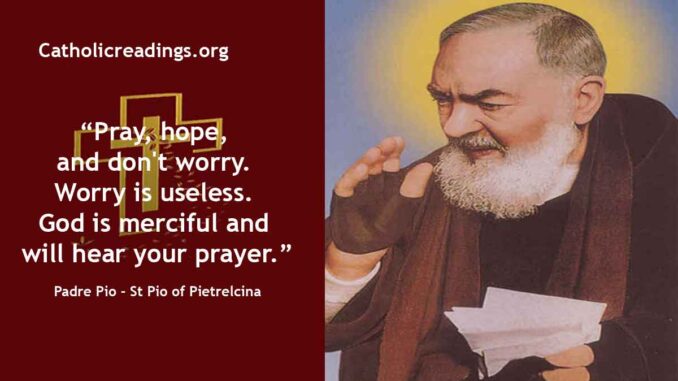 Padre Pio – St Pio of Pietrelcina – Feast Day – September 23 2026 | |
| Date of Birth | May 25 1887 |
| Place of Birth | Pietrelcina, Benevento, Italy |
| Profession | Franciscan friar, priest, stigmatist, and mystic |
| Place of Work | San Giovanni Rotondo, Italy |
| Date of Death | September 23, 1968 (aged 81) |
| Place of Death | San Giovanni Rotondo, Foggia, Italy |
| Feast Day | September 23 |
| Beatification | By Pope John Paul II on May 2 1999 at Saint Peter’s Square, Vatican City |
| Canonization | By Pope John Paul II on June 16 2002 at Saint Peter’s Square, Vatican City |
| Patron Saint of |
|
Quick Facts About Padre Pio
- Full religious name: St. Pio of Pietrelcina
- Popular name: Padre Pio
- Birth name: Francesco Forgione
- Born: May 25, 1887
- Place of birth: Pietrelcina, Benevento, Italy
- Parents: Grazio Mario Forgione and Maria Giuseppa De Nunzio
- Religious order: Order of Friars Minor Capuchin
- Profession and vocation: Capuchin friar, Catholic priest, confessor, and spiritual director
- Ordained: August 10, 1910, at Benevento
- Principal place of ministry: San Giovanni Rotondo, Italy
- Died: September 23, 1968, aged 81
- Place of death: San Giovanni Rotondo, Italy
- Beatified: May 2, 1999, by Pope John Paul II
- Canonized: June 16, 2002, by Pope John Paul II
- Feast day: September 23
- Liturgical celebration: Memorial
- Liturgical color: White
- Patron saint of: Adolescents, civil defense volunteers, and Pietrelcina
- Common symbols: Brown Capuchin habit, priestly stole, crucifix, Rosary, gloves covering his hands, and the wounds of Christ
Padre Pio – Saint Pio of Pietrelcina, Priest Birth and Family Life History
Padre Pio was born Francesco Forgione on May 25, 1887, in the rural village of Pietrelcina in southern Italy. He was baptized the following day.
His parents, Grazio Mario Forgione and Maria Giuseppa De Nunzio, were poor farmers. They worked hard and lived a simple Catholic life. Francesco was one of their surviving children; other children in the family died during infancy.
The Forgione family did not have much money, but prayer was central to their home. They attended Mass, prayed the Rosary, observed feast days, and taught their children the Catholic faith.
Francesco began showing a strong attraction to prayer at an early age. According to accounts of his childhood, he decided at about five years old that he wanted to dedicate his life to God.
When he was around ten, he met a bearded Capuchin friar who was collecting donations. The encounter strengthened Francesco’s desire to become a friar.
His family supported his vocation. Because he needed more education before entering the Capuchins, his father traveled abroad to earn money for his studies. His father worked in Jamaica, New York, to support the family.
This sacrifice reminds us that Padre Pio’s vocation was nurtured not only by his own desire but also by a family willing to suffer so that he could answer God’s call.
Becoming Brother Pio
On January 6, 1903, at the age of sixteen, Francesco entered the Capuchin novitiate at Morcone.
On January 22, he received the Franciscan habit and took the religious name Brother Pio. His new name honored Pope St. Pius V, who was venerated in the Pietrelcina area.
At the end of his novitiate, Brother Pio made his temporary vows. On January 27, 1907, he made his solemn profession, committing himself fully to poverty, chastity, and obedience.
His religious formation was difficult because he suffered from poor health. He frequently experienced stomach trouble, fever, weakness, and other illnesses. At times, his superiors allowed him to return home because the climate there seemed to help him.
Despite these problems, he continued his studies and formation for the priesthood.
Ordination and Early Priesthood
Brother Pio was ordained a priest on August 10, 1910, at Benevento. From then on, he became widely known as Padre Pio—Father Pio.
Because of his poor health, he spent several years near his family in Pietrelcina. In September 1916, he was sent to the Capuchin friary of Our Lady of Grace in San Giovanni Rotondo.
He remained connected with that community for the rest of his life.
During the First World War, Padre Pio was called into military service more than once. His illnesses repeatedly interrupted that service, and he was eventually discharged because of poor health.
His true battlefield would be spiritual. He would fight despair with hope, sin with mercy, and suffering with prayer.
Padre Pio and the Stigmata
The stigmata are wounds resembling those suffered by Jesus during His Crucifixion.
Padre Pio reported an early experience of the stigmata in 1910. He prayed that the visible wounds would disappear while the pain remained. The best-known event occurred on September 20, 1918.
While praying after Mass, Padre Pio experienced a vision. When it ended, wounds appeared on his hands, feet, and side. These wounds remained visible for about fifty years and caused him considerable pain.
Doctors examined him, Church authorities investigated, and public interest grew. Some people believed immediately. Others remained doubtful. The attention caused Padre Pio deep embarrassment and suffering.
What is certain is that the stigmata became closely associated with Padre Pio’s life and his intense devotion to Christ’s Passion.
Pope John Paul II explained that the wounds showed Padre Pio’s deep union with the suffering and risen Christ.
Restrictions and Obedience
Padre Pio’s growing reputation brought large crowds to San Giovanni Rotondo. People came seeking confession, spiritual advice, healing, and prayer.
Church authorities had a duty to investigate the claims surrounding him. During certain periods, restrictions were placed on his public ministry. He was at times prevented from celebrating Mass publicly or hearing confessions.
These restrictions caused him great pain. Yet he did not abandon the Church. He did not begin a movement against his superiors. He did not use his popularity to present himself as more important than Church authority. He obeyed.
Over time, many of the restrictions were relaxed. In 1933, he was again permitted to celebrate Mass publicly, and in 1934 he resumed hearing confessions.
His obedience during misunderstanding remains one of the strongest signs of his spiritual character.
Ministry of Confession and the Eucharist
Padre Pio spent much of his priestly life celebrating Mass, praying, guiding souls, and hearing confessions.
People sometimes waited for days to confess to him. His ministry in the confessional could occupy many hours of his day. He called people to sincere repentance and refused to treat confession as an empty religious routine.
He could be gentle with a frightened sinner and firm with someone who refused to take responsibility. His purpose was not to humiliate people. It was to lead them to an honest encounter with God’s mercy.
The celebration of Mass stood at the center of his life. He celebrated slowly and prayerfully, with deep attention to Christ’s sacrifice.
Padre Pio described himself simply as “a poor brother who prays.”
That description reveals the heart of his spirituality. Beneath the crowds, extraordinary reports, and worldwide attention stood a friar who wanted to pray.
Reported Spiritual Gifts
Many people who met Padre Pio reported extraordinary experiences connected with his ministry. These included healings, knowledge of hidden personal circumstances, conversions, prophecy, a distinctive fragrance, and bilocation, the reported ability to appear in a distant location without traveling there normally.
Such reports are part of the testimony surrounding his life, but they should never distract from the ordinary foundations of his holiness:
- Prayer
- The Eucharist
- Confession
- Obedience
- Charity
- Humility
- Care for the sick
- Faithfulness during suffering
Padre Pio did not ask people to build their faith on extraordinary events. He directed them toward Jesus Christ.
Padre Pio and Karol Wojtyła
In 1948, Padre Pio heard the confession of a young Polish priest named Father Karol Wojtyła. That priest later became Pope John Paul II.
Years later, Archbishop Wojtyła asked Padre Pio to pray for a Polish woman suffering from cancer. It was reported that she recovered from her serious illness.
It was during the pontificate of Pope John Paul II that Padre Pio was beatified and canonized.
House for the Relief of Suffering
Padre Pio did not speak about suffering from a safe distance. He endured illness, physical pain, suspicion, restrictions, and heavy spiritual burdens.
But he did more than endure suffering. He worked to relieve it.
His greatest charitable project was the Casa Sollievo della Sofferenza, meaning the House for the Relief of Suffering. The hospital opened in San Giovanni Rotondo on May 5, 1956.
Padre Pio wanted it to combine excellent medical care with respect for the spiritual dignity of every patient. It was to be a place where science, compassion, and faith worked together.
The hospital became one of his most enduring legacies. It showed that authentic spirituality does not ignore physical suffering. Prayer must move the believer toward practical love.
Padre Pio also encouraged the formation of prayer groups. These communities brought people together to pray for the Church, the suffering, and the needs of the world.
The Death of Padre Pio
Padre Pio’s health deteriorated during the final years of his life, but he continued celebrating Mass and hearing confessions as long as he could.
On September 20, 1968, he marked the fiftieth anniversary of the visible stigmata. His final days were marked by increasing weakness.
During the early hours of September 23, Padre Pio made his confession and renewed his vows of poverty, chastity, and obedience. He died in his cell at San Giovanni Rotondo at approximately 2:30 a.m. He was 81 years old.
His funeral took place on September 26. More than 100,000 people reportedly gathered to honor the humble friar who had spent his life directing people toward Christ.
He was originally buried in the crypt of the Church of Our Lady of Grace in San Giovanni Rotondo. His remains were later exhumed, examined, and placed for public veneration.
They are now associated with the Shrine of St. Pio of Pietrelcina in San Giovanni Rotondo, one of the world’s best-known Catholic pilgrimage destinations.
Feast Day of Padre Pio
The Catholic Church celebrates the Memorial of St. Pio of Pietrelcina on September 23, the date of his death.
The liturgical color is white, which is used for saints who were not martyrs.
On his feast day, Catholics remember his devotion to:
- The Holy Eucharist
- The Sacrament of Reconciliation
- The Passion of Jesus
- The Blessed Virgin Mary
- The Holy Rosary
- Prayer for sinners
- Care for the sick and suffering
- Obedience to the Church
His feast challenges Catholics to go beyond admiring his extraordinary experiences. The better way to honor Padre Pio is to return to confession, participate attentively in Mass, pray the Rosary, forgive others, and help someone who is suffering.
Beatification of Padre Pio
Padre Pio’s formal cause began after his death. On December 18, 1997, the decree recognizing his heroic virtues was promulgated in the presence of Pope John Paul II.
The healing of Consiglia De Martino of Salerno was examined as the miracle required for his beatification. After medical and theological investigation, the decree recognizing the miracle was promulgated on December 21, 1998.
Pope John Paul II beatified Padre Pio on May 2, 1999, during a solemn Mass connected with St. Peter’s Square.
The Church established September 23 as his liturgical memorial.
Canonization of Padre Pio
A second healing was considered during the canonization process. It involved Matteo Pio Colella, a young boy from San Giovanni Rotondo who became critically ill with a severe form of meningitis and fell into a coma.
His unexpected recovery was investigated by medical experts and Church authorities. The decree recognizing the miracle was promulgated in the presence of Pope John Paul II on December 20, 2001.
Pope John Paul II canonized Padre Pio on June 16, 2002, in St. Peter’s Square. More than 300,000 people attended the celebration and filled the surrounding streets.
During the canonization, the pope presented Padre Pio’s prayer and charity as the clearest summary of his life.
What Is Padre Pio the Patron Saint Of?
Padre Pio is commonly honored as the patron saint of:
- Adolescents
- Civil defense volunteers
- Pietrelcina
- People seeking relief from stress
- Those seeking spiritual healing
He is connected with civil defense volunteers partly because of the strong devotion shown to him by such workers in Italy.
Young people look to him as a patron because his vocation became clear while he was still young. His life encourages adolescents to take their faith and God-given purpose seriously.
People experiencing stress, fear, illness, or spiritual struggle frequently ask for his intercession because he endured many physical and emotional trials without surrendering his trust in God.
How Padre Pio Is Represented in Art
Padre Pio is easy to recognize in Catholic art and devotional images. He is usually shown:
- Wearing the brown Capuchin habit
- With a white beard
- Holding a crucifix or Rosary
- Wearing fingerless gloves that covered the wounds on his hands
- Raising a wounded hand in blessing
- Hearing a confession
- Celebrating Mass
- Surrounded by warm light
- Standing near the House for the Relief of Suffering
The brown habit represents Franciscan poverty and simplicity. The crucifix recalls his deep union with Christ’s suffering. The Rosary points to his devotion to the Blessed Virgin Mary. The gloves recall the stigmata but also his desire not to display the wounds unnecessarily.
The Legacy of Padre Pio
1. Prayer Must Become a Daily Weapon
Padre Pio taught people to pray during fear, sickness, uncertainty, and temptation.
Many people today reach for their phones the moment anxiety begins. They search endlessly, read frightening news, and replay the problem in their minds. Padre Pio offers a different first response: turn to God.
Practical action: Before checking your phone tomorrow morning, spend ten minutes in prayer. Present your fears to God by name.
2. Confession Is a Place of Healing
Padre Pio devoted countless hours to hearing confessions because he knew that sin wounds the human heart.
We often try to manage guilt by hiding it, explaining it away, or blaming someone else. But hidden guilt does not produce freedom.
Practical action: If you have been away from confession, find the next available opportunity and return sincerely to the sacrament.
3. Suffering Must Lead Us Toward Compassion
Padre Pio suffered greatly, but he did not use suffering as an excuse to become bitter. He allowed it to deepen his concern for others.
His hospital transformed compassion into action.
Practical action: Help one sick, elderly, grieving, or overwhelmed person this week. Call them, visit them, provide a meal, arrange transport, or help meet a practical need.
4. Obedience Matters When We Feel Misunderstood
Padre Pio faced suspicion and restrictions. Yet he remained faithful to the Church and obedient to his superiors.
Modern culture often tells us that any correction is an attack. Padre Pio teaches us to examine ourselves, remain humble, and distinguish personal pain from genuine injustice.
Practical action: Before reacting defensively to correction, pray and ask whether God may be teaching you patience or humility.
5. Do Not Let Worry Control Your Life
Padre Pio is widely remembered for the advice: “Pray, hope, and don’t worry.”
This does not mean ignoring responsibilities. It means doing what we can while refusing to behave as though everything depends entirely on us.
Practical action: Write down one worry. Under it, write one action you can take and one part you must entrust to God.
What Can We Learn from Padre Pio Today?
You may not carry visible wounds. But perhaps your heart carries wounds nobody sees.
You may be caring for a sick family member. Fighting anxiety. Struggling with sin. Waiting for employment. Living with false accusations. Praying for a child who has walked away from God.
Padre Pio does not tell you that suffering is easy. His life tells you that suffering does not have to be empty.
Take it to the Cross. Bring it to Mass. Speak honestly in confession. Pray the Rosary. Seek proper medical and professional help when needed. Then allow your pain to make you more compassionate, not more bitter.
Today, choose prayer over panic. Hope over despair. Faithful action over endless worry.
Prayer
St. Pio of Pietrelcina, faithful priest and humble servant of Christ, pray for us in our suffering and uncertainty. Help us to love the Eucharist, seek God’s mercy in confession, pray with perseverance, obey with humility, and care for those who are sick or forgotten. Lead us closer to the wounded and risen Jesus, and help us place every fear in His hands. Amen.
If the life of Padre Pio has encouraged you, please like and share this post so that another person may discover his powerful example of prayer, hope, and charity.
Subscribe to and follow our Facebook, YouTube, WhatsApp, X and Threads channels for Catholic Daily Readings, Reflections, Saint of the Day, Prayers, History, Motivation, Inspiration and Encouragement.
Related Links
Powered By SEO Experts
Follow @ReadingCatholic
