
October 15 is especially important in the Catholic Church because it is the Memorial of St. Teresa of Jesus, better known as St. Teresa of Ávila, one of the greatest spiritual writers in Catholic history and a Doctor of the Church.
The date has also witnessed the death of a pope during the Western Schism, the first day of the Gregorian calendar, the death of St. Teresa herself, important papal teachings, the founding of a major Catholic institute for Eastern Christianity.
The date also has the conclave that would elect St. John Paul II, major gatherings of Catholic families, large canonizations and a modern papal document on trust in God.
Here are 10 memorable and significant events connected with Catholic Church history on October 15.
1. October 15, 1389 – Pope Urban VI Dies During the Western Schism
On October 15, 1389, Pope Urban VI died in Rome after serving as pope for more than eleven years. His pontificate took place during one of the most painful periods in Catholic history, known as the Western Schism.
During this time, rival claimants to the papacy were supported by different European countries. Urban VI remained in Rome while another claimant ruled from Avignon in France.
The division caused great confusion among Catholics because different nations recognized different popes. Urban’s death did not end the crisis. The schism continued for many more years before Church unity was finally restored at the Council of Constance.
2. October 15, 1582 – The Gregorian Calendar Officially Begins in Several Catholic Countries
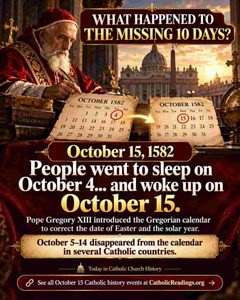
October 15, 1582 became one of the most unusual dates in history. In the Papal States, Spain, Portugal and several other Catholic territories, Thursday, October 4 was followed immediately by Friday, October 15. Ten dates were removed from the calendar.
Pope Gregory XIII had ordered the reform because the old Julian calendar was slowly moving out of line with the solar year. This was creating problems for calculating the date of Easter.
The new system became known as the Gregorian calendar. Other countries adopted it much later, but it eventually became the civil calendar used by most of the world today. OUPblog
3. October 15, 1582 – St. Teresa of Ávila Dies
The same extraordinary calendar change is closely connected with St. Teresa of Ávila. Pope Benedict XVI explained that Teresa’s earthly life ended on the night of October 15, 1582, at Alba de Tormes in Spain.
She had spent years reforming Carmelite religious life and founding new convents. Teresa became famous for her teaching about prayer and her books, including The Interior Castle and The Way of Perfection.
She was canonized in 1622. In 1970, Pope Paul VI declared her a Doctor of the Church, making her the first woman to receive that title. Her feast is celebrated every October 15.
4. October 15, 1890 – Pope Leo XIII Issues a Major Warning About Freemasonry in Italy
On October 15, 1890, Pope Leo XIII issued the encyclical Dall’Alto dell’Apostolico Seggio. The document dealt especially with Freemasonry and the difficult relationship between the Catholic Church and political movements in Italy.
Leo XIII believed that some groups were working to weaken Catholic faith and remove Christian influence from public life. He encouraged Italian Catholics to remain faithful to the Church and to protect Christian education, marriage and family life.
The document reflects a period when relations between the papacy and the newly united Italian state were very tense. It gives us a picture of the serious religious and political struggles facing Catholics in nineteenth-century Italy.
5. October 15, 1917 – Pope Benedict XV Establishes the Pontifical Oriental Institute
On October 15, 1917, Pope Benedict XV founded the Pontifical Oriental Institute in Rome through the document Orientis Catholici.
The institute was created to study the history, theology, liturgy and traditions of the Eastern Christian Churches. Benedict XV wanted Catholics in the West to understand Eastern Christianity better and wanted clergy to receive proper training before serving Eastern Catholic communities.
The institute later became an important centre for the study of Eastern Catholic and Orthodox traditions. Its work has helped the Catholic Church preserve the rich traditions of Eastern Christianity and encouraged better understanding between Christians of the East and West.
6. October 15, 1978 – Cardinals Vote but Fail to Elect a Pope
On October 15, 1978, 111 cardinals spent the day voting in the Sistine Chapel to choose a successor to Pope John Paul I, who had died after only 33 days as pope.
Four ballots were held that day, but none produced the required majority. Black smoke rose from the chimney, telling the crowds outside that no pope had yet been elected.
The conclave continued the following day. On October 16, the cardinals elected Cardinal Karol Wojtyła of Poland, who became Pope St. John Paul II. He was the first non-Italian pope in more than 450 years and would serve the Church for more than 26 years.
7. October 15, 1991 – Pope John Paul II Celebrates Major Events During His Visit to Brazil
On October 15, 1991, Pope John Paul II continued his apostolic journey through Brazil. He celebrated Mass in Brasília and later visited Goiânia, where he celebrated another major liturgical gathering.
He also met Catholic seminarians and representatives of the Jewish community. John Paul II regularly used his journeys to encourage Catholics while also building friendship with people of other religions.
Brazil was and remains home to one of the world’s largest Catholic populations, so his visit attracted enormous attention. The Pope encouraged Brazilian Catholics to remain faithful to Christ while working for justice, human dignity, peace and stronger communities.
8. October 15, 2000 – Pope John Paul II Celebrates the Jubilee of Families
On October 15, 2000, Pope John Paul II celebrated Mass in St. Peter’s Square for the Jubilee of Families during the Great Jubilee Year. Catholic families had travelled to Rome from many countries for the Third World Meeting of Families.
The gathering focused especially on children and their importance in both the family and society. The Church wanted to encourage married couples, parents and children to see family life as a place where Christian faith is learned and lived every day.
The Jubilee showed John Paul II’s strong belief that families need spiritual, social and pastoral support and that healthy families are important for the future of society.
9. October 15, 2017 – Pope Francis Declares 35 New Saints
On October 15, 2017, Pope Francis canonized 35 new saints in St. Peter’s Square. Most were martyrs. They included priests and lay Catholics killed during anti-Catholic persecution in Brazil in 1645, as well as three young Indigenous Mexican martyrs – Cristóbal, Antonio and Juan. Also canonized were St. Faustino Míguez and St. Angelo of Acri.
Pope Francis said that the new saints had not simply said “yes” to God with words but had remained faithful throughout their lives. The ceremony showed how Catholic saints come from very different countries, cultures and backgrounds and how some paid for their faith with their lives.
10. October 15, 2023 – Pope Francis Publishes C’est la Confiance
On October 15, 2023, Pope Francis published the Apostolic Exhortation C’est la Confiance, meaning “It Is Confidence.” The document was dedicated to St. Thérèse of Lisieux, another famous Carmelite saint and Doctor of the Church.
Francis focused especially on Thérèse’s teaching about trusting completely in God’s merciful love. He explained that her “little way” remains useful for Christians today because holiness does not depend on becoming powerful or famous.
It begins with trusting God and doing ordinary things with love. Francis deliberately published the document on October 15, the feast of St. Teresa of Ávila, connecting two great Carmelite women.
Saint of the Day – St. Teresa of Ávila
October 15 is the Memorial of St. Teresa of Jesus, Virgin and Doctor of the Church, usually called St. Teresa of Ávila.
Teresa was born in Spain in 1515.
She became a Carmelite nun and eventually became convinced that Carmelite religious life needed renewal.
She founded new convents where the sisters would live more simply and spend more time in prayer.
Teresa also became one of the greatest teachers about Christian prayer.
She wrote openly about her struggles, distractions and difficulties, making her spiritual teaching very practical.
Her most famous books include The Interior Castle, The Way of Perfection and her autobiography.
Pope Paul VI declared her a Doctor of the Church in 1970.
Her life gives a simple lesson: Prayer is not running away from real life. True prayer should give us strength to love God and serve people better.
The Amazing October 15 Calendar Story
October 15 has one of the strangest stories of any date in Catholic history.
In 1582, people in several Catholic countries went to bed on October 4.
When they woke up the next morning, the date was October 15.
October 5 through October 14 were removed from that year’s civil calendar.
Nothing happened to time itself. The Church was simply correcting the way dates were counted.
This was done because the Julian calendar had slowly drifted away from the true solar year and from the traditional calculation of the spring equinox used in determining Easter.
That gives October 15 an unusually strong historical hook: “Did you know that in 1582, October 15 came immediately after October 4?”
What Can We Learn From October 15?
October 15 gives us several important lessons.
Pope Urban VI reminds us how painful division inside the Church can become.
The Gregorian calendar shows that even systems used for centuries sometimes need correction.
St. Teresa of Ávila teaches the power of prayer, courage and reform.
The Pontifical Oriental Institute reminds us to respect the different traditions that exist inside the worldwide Catholic Church.
The 1978 conclave reminds us that major historical changes can begin quietly behind closed doors.
The Jubilee of Families reminds us that faith is also built in ordinary homes.
The saints of 2017 show courage.
And C’est la Confiance reminds us to trust God even when we feel small or weak.
The message of Catholic Church history October 15 is simple: pray deeply, keep learning, correct what needs correcting, seek unity and trust completely in God.
Please like and share the post, subscribe to our YouTube channel, and follow us on Facebook, WhatsApp, X, and Threads. Find more Today in the Catholic Church History at CatholicReadings.org.
Follow @ReadingCatholic
